

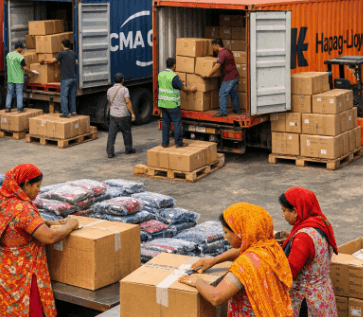

Bangladesh has moved ahead of China to become the second-largest apparel exporter to the United States, even though its own sales to that market fell in the early part of the year. Recent customs data shows that Bangladesh shipped garments worth $1.37 billion, down 8.53% from $1.5 billion a year earlier, while China’s exports dropped much more sharply to $1.17 billion from $2.77 billion. Vietnam stayed in first place with $2.7 billion in shipments, showing that the top spot in the US market remains strong even as the wider trade picture changes.
The shift highlights a changing global apparel market shaped by tariff pressure, weaker demand, and supply chain changes. Total US apparel imports fell to $11.53 billion from $13.55 billion, a drop of 13.47%, which shows that the whole market is under strain, not just one country. Bangladesh’s rise in rank is therefore important, but it does not mean the industry is in a fully strong position. The ranking improved because China fell faster, not because Bangladesh posted growth in this period.
Industry leaders in Bangladesh have warned against reading too much into the new ranking. They say higher tariffs, global conflicts, and energy and logistics problems are hurting export performance and making business less predictable. Their message is that the sector still needs policy support, steady energy supply, and better domestic conditions if it is to regain momentum and hold its place in a tough market. This is especially important for a sector that supports a large share of the country’s industrial jobs and export earnings.
At the same time, the latest figures follow a stronger year before the slowdown. Bangladesh’s ready-made garment exports to the United States reached $8.20 billion in the previous year, up 11.75% from $7.34 billion, while shipment volume also increased to 2.66 billion square metres from 2.36 billion. That earlier growth shows that the country still has strong market appeal when conditions are more stable. The challenge now is to protect that progress by improving efficiency, reducing costs, and strengthening the supply chain from factory to shipping line. If Bangladesh can do that, its recent rise could become more than a short-term result and turn into a lasting gain in the world’s biggest clothing market.