

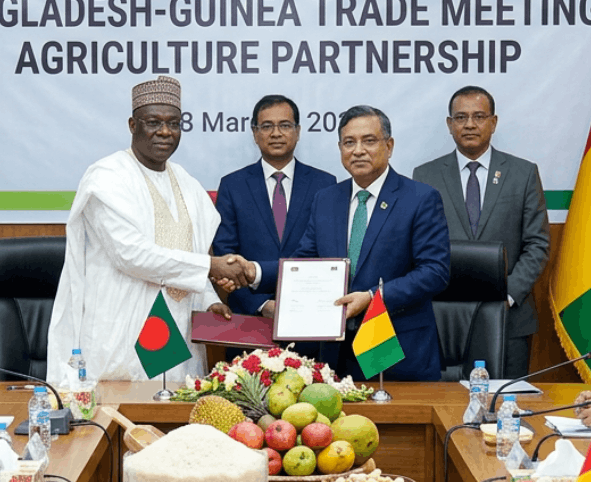

Bangladesh and Guinea have agreed to work more closely on agriculture, trade, and investment, with a special focus on contract farming and stronger business links between companies in both countries. The talks took place during a bilateral meeting in Dakar, where Bangladesh’s State Minister for Foreign Affairs met Guinea’s Foreign Minister on the sidelines of a peace and security forum in Africa. Both sides said they want to build a more practical partnership that can create new opportunities for farmers, traders, and investors. Agriculture was at the center of the discussion, and contract farming was named as one of the main areas for cooperation. That idea could help link producers and buyers more directly, which may improve planning, reduce uncertainty, and open the door to more stable trade. The two countries also spoke about encouraging business-to-business exchanges, which can help companies find new partners and understand each other’s market needs better. Along with agriculture, the meeting identified mineral resources, garments and textiles, and pharmaceuticals as promising sectors for future cooperation. This wider list shows that both sides are looking beyond one field and exploring several ways to grow economic ties. For Bangladesh, the talks support a broader effort to expand trade relations with African countries and create new markets for its products and services. For Guinea, the discussion offers a chance to attract more investment and learn from Bangladesh’s experience in manufacturing and export-based growth. The focus on contract farming is especially important because it can help farmers gain better access to markets while giving buyers a more reliable supply chain. At the same time, the interest in garments, textiles, and pharmaceuticals shows that both sides see value in sectors where Bangladesh already has strong experience. If these ideas move forward, they could lead to more trade, more investment, and closer contact between public and private leaders. The meeting also showed the growing importance of regional and cross-continental partnerships in today’s economy. Rather than relying only on traditional trade routes, countries are now looking for new links that can support long-term growth and better market access. For Bangladesh and Guinea, this step may be a useful starting point for stronger economic ties built on shared interests, practical cooperation, and future business opportunities.