

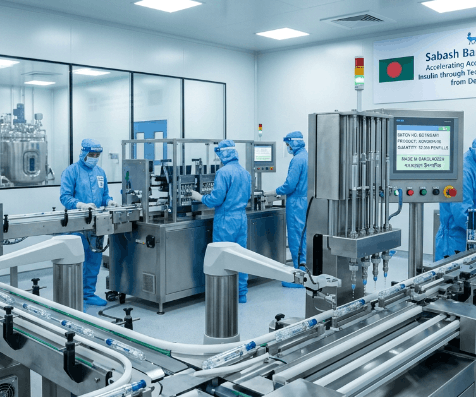

Bangladesh has started producing modern insulin locally for the first time, marking a major step for the country’s healthcare and pharmaceutical sectors and offering relief to millions of people living with diabetes. The new production comes through a technology transfer partnership between Eskayef Pharmaceuticals Ltd. and Denmark-based Novo Nordisk, allowing Bangladesh to make advanced insulin products at home under internationally standardized processes. The agreement covers premix and rapid-acting insulin cartridges, which are widely used in diabetes care, and each batch will be verified in Denmark to make sure it meets global quality and safety standards.
The move is expected to make treatment more affordable and more secure for patients who depend on insulin every day. Novo Nordisk’s Bangladesh unit has already announced an 18% price cut for key products such as NovoMix® and NovoRapid®, and the start of local manufacturing is meant to support that lower cost. Officials say the step can also reduce reliance on imports, limit the impact of global price swings, and make supply more stable inside the country. That matters because insulin is not a medicine that patients can easily go without, and steady access can be as important as price.
The timing is important as well. The report says Bangladesh currently has nearly 13 million people with diabetes, and that number could rise to around 22 million by 2045 if the trend continues. In that setting, a stronger domestic supply chain can help the health system respond more safely and more quickly to growing demand. The article also frames the development as more than a health story. It shows Bangladesh moving deeper into high-value biopharmaceutical manufacturing, which is a bigger and more technical field than generic drug production.
Industry observers say that if the technology transfer works smoothly, Bangladesh could become more attractive to other international partners looking for reliable production capacity in the region. For now, the immediate gain is clear: lower prices, local production, and better access for patients who need insulin to manage their condition. The longer-term gain could be even bigger if the country uses this experience to build stronger skills, better facilities, and more confidence in advanced drug manufacturing. For Bangladesh, this is a practical step toward a more self-reliant health sector and a more capable pharmaceutical industry.