

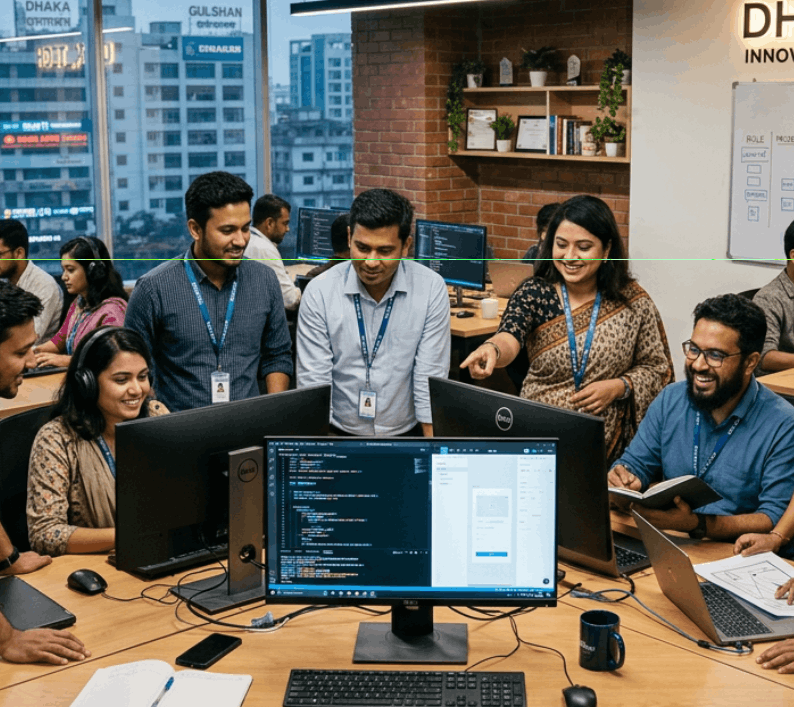

Bangladesh’s software industry is showing a new level of maturity, with export earnings crossing $1.6 billion in FY2024-25 and local firms taking on longer, more demanding projects for clients in North America, Europe, and the Asia-Pacific. The source says the sector’s rise has been helped by tax-free export status, the spread of high-tech parks in Dhaka, Chittagong, and Sylhet, and a talent pool of more than 50,000 computer science graduates each year. But the article makes a bigger point too: the strongest software companies in Bangladesh are no longer competing mainly on price. They are building long-term engineering partnerships, earning certifications, and developing the kind of process discipline that keeps clients coming back.
The list highlights companies with different strengths. Dynamic Solution Innovators, founded in 2001, is one of the oldest players and now has more than 300 engineers, deep client relationships, and compliance credentials including CMMI Level 3, ISO 27001, ISO 20000, ISO 9001, and SOC 2 Type II. Its work includes OpenCRVS, Black Duck support, long-term work with Jenzabar, and national digital systems in Bangladesh, including ODMS for import-export cargo and an information management system for primary education. Brain Station 23 stands out for scale, with more than 800 engineers and strong work in web, mobile, ERP, CRM, game development, and Microsoft technologies.Cefalo has built a model around dedicated teams for Nordic clients, while Therap (BD) Ltd serves as the engineering hub for a US health record platform used across all 50 US states and supports more than 300,000 care providers.
Other firms show how specialized the market has become. Vivasoft has grown in cloud engineering and staff augmentation, Enosis works as an embedded development center for US software companies, SELISE runs major enterprise work from Dhaka for banking, insurance, telecom, and manufacturing, and Tiger IT has become known for national-scale identity and biometrics systems, including Bangladesh’s own National ID infrastructure. Riseup Labs has delivered more than 700 projects in over 20 countries and has expertise in AR, VR, mixed reality, gaming, and IoT, while Kaz Software has focused on healthcare IT, education technology, and fintech.
The article’s broader message is that Bangladesh is building a software sector with depth, not just volume. Many of these firms have spent more than a decade refining their engineering teams, certifications, and client processes, which makes them more credible partners for complex, long-running work. That shift matters because it shows how the country’s tech industry is moving from service delivery alone toward durable innovation, stronger exports, and a more trusted place on the global software map.