

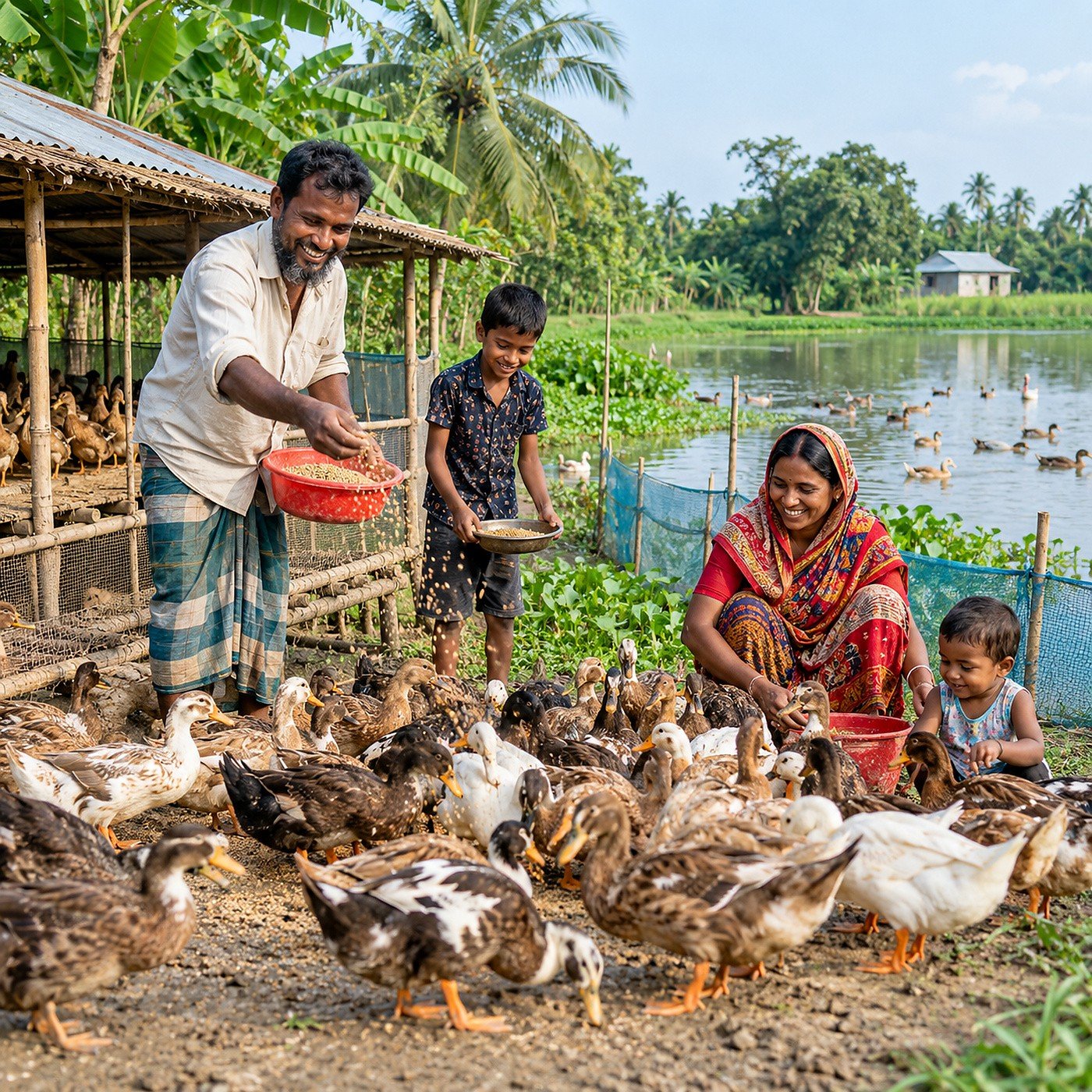

Commercial duck farming is gaining popularity among marginal farmers in Dacope, Khulna, creating an accessible source of income in an area where rivers, canals and wetlands offer favourable conditions for the birds. Local farmers are raising ducks for eggs and meat, while natural water resources help lower feeding costs because the birds can find a large share of their food from the surrounding environment. The model is attractive for smaller households because it can be started at different scales and expanded gradually as farmers gain experience. Some farmers in the area report annual earnings of around Tk2 lakh to Tk3 lakh, showing how a well-managed duck farm can become a meaningful livelihood. Individual examples range from farms with a few hundred birds to operations with around 2,000 ducks. Local demand also supports the business. Eggs and ducks can be sold to nearby markets, restaurants and traders, giving farmers a relatively direct route to customers. Training, vaccination and veterinary support are helping improve the quality of farming as the activity expands. These services are important because healthy birds, proper housing and disease prevention can protect both farmer income and food safety. Duck farming also fits the local landscape. In wet areas, birds can use ponds, canals and other water bodies while farmers combine the activity with other rural work. Natural feeding can account for a substantial part of the ducks’ diet, reducing dependence on purchased feed and making production more affordable. The wider opportunity is to build stronger value chains around this growth. Farmers could benefit from better access to quality ducklings, veterinary medicine, small loans, egg collection, cold storage and organised marketing. Cooperative or group-based selling could also help smaller producers negotiate better prices. As production increases, local entrepreneurs may find opportunities in feed supply, transport and processing. The story from Dacope shows that agricultural growth does not always require large farms or expensive machinery. A livelihood can improve through a locally suitable activity, practical training and reliable market demand. If support services continue and farmers maintain good health standards, commercial duck farming can provide steady income, create rural jobs and diversify household earnings in the coastal region of Bangladesh.