

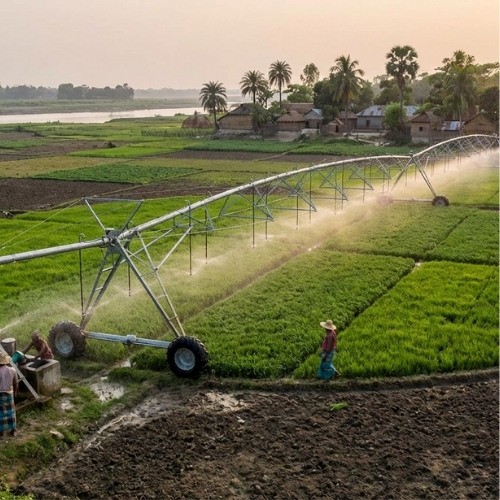

Trials of a new mechanised irrigation system are underway in Bangladesh, promising big water and labour savings for farms. The Bangladesh Agricultural Development Corporation is testing centre-pivot irrigation at Muladuli farm in Ishwardi, Pabna, and at a sugarcane farm in Bhabanipur, Natore, using Austrian technology after engineers trained BADC staff and local farmers. The centre-pivot system uses a long pipe on wheeled towers that turns around a central pivot and sprinkles water evenly, which fits crops needing light, regular watering rather than flood irrigation. BADC staff say the machine can cut water use by 20 to 30 percent compared with older methods, giving practical figures: wheat that might use 100,000 to 200,000 litres per bigha with flood systems may need only 70,000 to 160,000 litres with pivot irrigation, depending on soil and weather. Farmers have noticed the time gains: an area that used to take 25 to 30 days to cover with flood irrigation can be watered in 5 to 7 days with the pivot, freeing labour for other tasks and lowering seasonal costs. The system can be run from a control panel so operators give water only where and when a crop needs it, which stops over-watering and helps crops like onion, wheat, maize and vegetables that can suffer from standing water. It is not meant for paddy fields, which still need flood irrigation. At the Muladuli trial the pivot reaches a wide radius and the six-span setup irrigates a very large plot, but engineers say the same idea can be scaled down to a single span for smaller farms, making the technology flexible for different users. Officials expect higher yields where water and timing are better controlled; one local manager says sugarcane yields could rise from 15–17 tonnes per acre to nearly 27–30 tonnes with careful irrigation and crop care. Farmers who saw early demonstrations called the system a blessing because it cuts the need to hire many workers and avoids damage from excess water in sensitive crops. The trial cost about Tk 4 crore and included ongoing links with the Austrian team for maintenance and fine tuning. Final power connections and last checks are being completed before a public opening, and BADC says it will consider wider installations if tests keep showing strong results. To spread the benefit, planners note the need for simple finance options, village-level training, and reliable power so smallholders can use smaller pivots without high upfront risk. If tests succeed and practical supports arrive, the mechanised pivots could help many farmers save water, cut labour bills and grow stronger crops while moving Bangladesh toward more modern and climate-smart farming. Wider use could also protect groundwater and make harvests more reliable for farming families.