

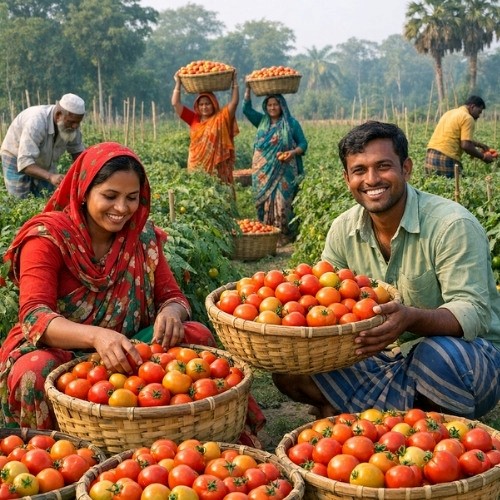

Tomato farming has become a major new source of income in Rajshahi, bringing steady cash to farmers and traders and changing local livelihoods. Growers across Godagari, Tanore and Paba upazilas are harvesting from about 3,500 hectares, and local officials estimate the season now generates roughly Taka 100 crore in trade, which is why many families are shifting part of their land to tomato plots. Wholesale prices are healthy, generally between Taka 1,800 and Taka 2,000 per maund, and early harvests can fetch even higher rates, so traders often buy straight from fields to give farmers quick payment and reduce their market risk. Experts from the Department of Agricultural Extension note that tomatoes from Rajshahi are mostly free from chemical ripening agents, and that quality has helped build strong demand in big city markets. After mangoes, tomatoes have become the district’s second most important cash crop and the crop now directly involves more than one lakh families while creating jobs for many thousands more in transport, storage and marketing. Yields are good on the Barind tract, with many farmers reporting production between 60 and 70 maunds per bigha, and that has made tomato farming more profitable than several traditional field crops. One farmer in Premtali village planted tomatoes on five bighas and reported an early phase harvest of ten maunds which he sold at Taka 2,300 per maund, and another grower said hybrid varieties paid off after an investment of Taka 1.25 lakh produced sales of about Taka 30,000 at rates near Taka 70–75 per kilogram. These examples show how small to medium plots can quickly return money for families who need cash for school fees, farm inputs and household needs. Local officials and retired researchers point to soil and climate as big advantages: Rajshahi, Natore, Naogaon and Chapainawabganj have conditions that suit tomatoes, and Godagari alone produces roughly two thirds of the district’s output, making it a national hub for winter and early winter fruit. Farmers say platform-cultivated tomatoes that ripen naturally on the vine are especially popular because they reach markets as fresh fruit without artificial ripening, which raises buyer confidence and supports better prices. Traders from outside the district travel to buy large lots, and steady direct buying helps farmers plan their harvests and reduce post-harvest losses. To keep the momentum, extension officials suggest continued focus on seed choice, water use, storage facilities and simple training in handling and packing, while easy access to small loans would let more growers switch to higher-yielding varieties. With practical support, better market links and care for natural growing conditions, tomato cultivation in Rajshahi looks set to remain a strong, reliable and widely shared source of income for families across the region.